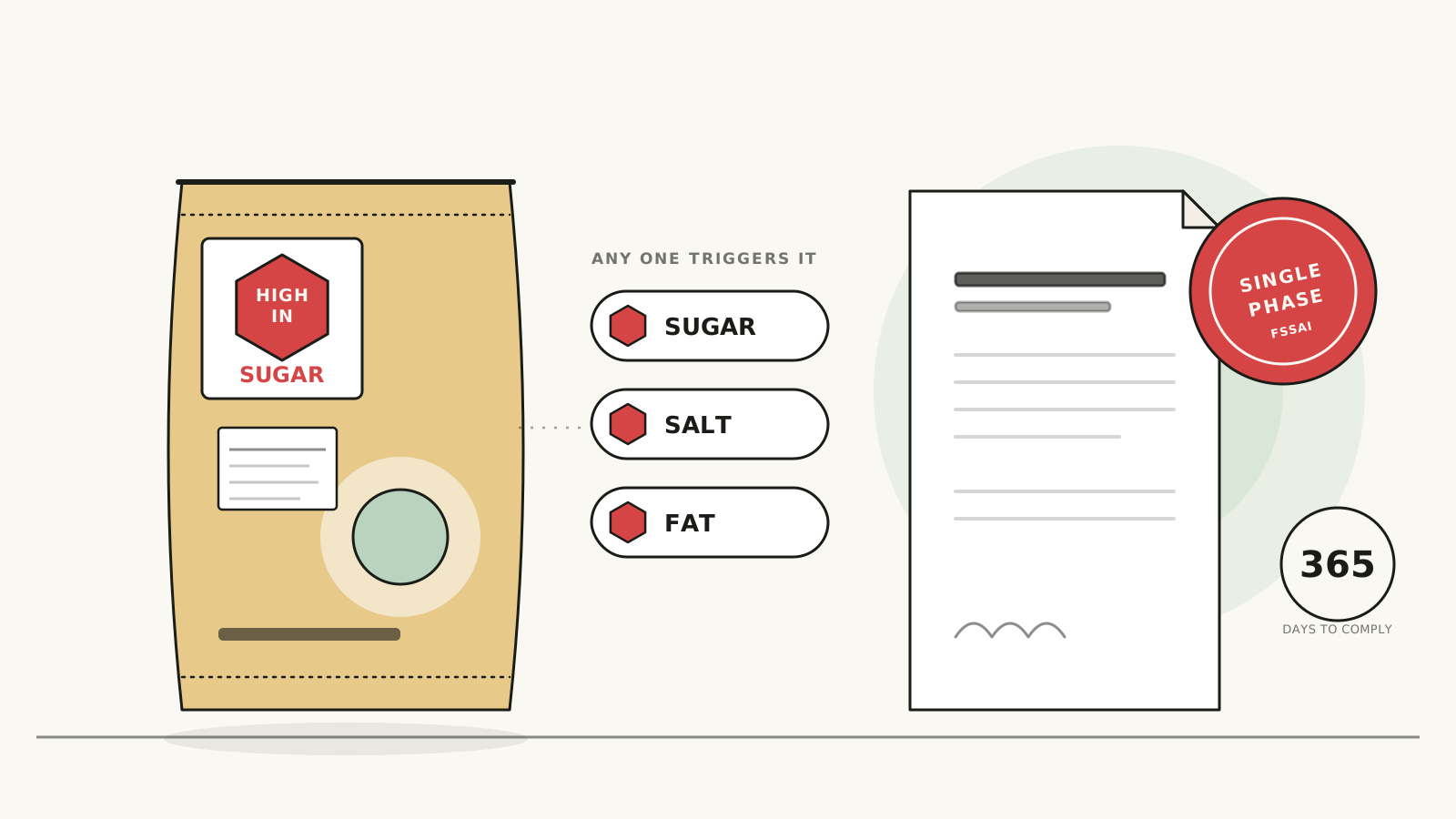
FSSAI just changed its own plan, and it did it inside a Supreme Court filing. In a compliance affidavit reportedly submitted on September 23 and 24, 2026, the regulator dropped its earlier two-phase approach to front-of-pack warning labels and told the Court it will now move in a single phase instead. Every packaged food high in even one nutrient of concern, meaning sugar, salt or fat, will need a red hexagon warning. Food companies will get roughly four months of rulemaking followed by a 365-day voluntary compliance window. If you make, pack or sell branded food in India, this filing is the clearest signal yet of what your label is going to look like next year.
Background: A Court That Wasn't Satisfied With FSSAI's First Answer
This all traces back to a public interest litigation filed by 3S and Our Health Society against the Union of India, a case now cited as 2026 LiveLaw (SC) 926. On September 10 and 11, 2026, a Supreme Court bench of Justice J.B. Pardiwala and Justice K. Vinod Chandran heard the matter and pushed back hard on FSSAI's original two-phase rollout plan for front-of-pack labelling (FoPL).
The bench reportedly asked FSSAI to clarify at least 13 separate points, including why products high in two or more nutrients were being prioritized over single-nutrient offenders, how nutrient thresholds would be calculated, whether the red hexagon's color risked confusing consumers who associate red with non-vegetarian food, and how schools would be expected to teach children to read the new labels. The Court gave the Centre and FSSAI ten days to file affidavits. FSSAI's response, filed within that window, is the single-phase proposal now on record. The next hearing is listed for September 28, 2026, just days away.
What "Single Phase" Actually Means for Your Label
Under FSSAI's original plan, only products crossing thresholds for two or more nutrients would have been flagged first, with single-nutrient offenders added later. That distinction is now gone. According to FSSAI's affidavit, any packaged food that exceeds the prescribed threshold for even one nutrient, sugar, salt or fat, will need a red hexagon on the front of the pack from day one of enforcement. That is a materially larger set of products than the original plan covered, and it means brands that assumed they had a longer runway because they only trip one threshold need to revisit that assumption immediately.
The thresholds themselves are reportedly drawn from the Dietary Guidelines for Indians, 2024, published by ICMR's National Institute of Nutrition. Added sugar is flagged around 5% of energy for solid foods and 10% of energy for beverages, while total sugar limits sit near 10% of energy for solids and 30% for beverages. Added fat is pegged around 15% of energy, with total fat capped near 30%.
The Design Rules and the Compliance Clock
The label itself is reportedly modelled on Canada's FoPL system: a red hexagon on a white square, placed prominently in the top-left corner of the front of pack, naming the nutrient or nutrients that triggered the warning. FSSAI has also proposed that the font used for the warning must be at least one point larger than the font used in the nutrition information table on the same pack, so the warning cannot be visually buried. A separate "contains non-calorific sweetener" declaration is reportedly moving from the back of the pack to the front as well.
On timing, FSSAI told the Court it needs about four months to draft final regulations, publish them for a mandatory 60-day stakeholder consultation that reportedly includes a WTO notification window, and secure ministry sign-off. Once notified, food businesses get a 365-day voluntary compliance period, which FSSAI has said is consistent with its existing labelling policy and is meant to avoid "commercial hardship" for companies sitting on pre-printed packaging stock. That means the earliest realistic enforcement date is likely more than a year away, but the design and reformulation work needs to start now, not when the rule is finalized.
What This Means for Your Business
- Audit your nutrient profile today. Run your SKUs against the added sugar, added fat and salt thresholds now, using added rather than total sugar and fat, so you know which products will need a hexagon under the single-phase plan.
- Don't wait for two-ingredient relief. The two-phase safety net that many single-nutrient offenders were counting on has reportedly been dropped, so plan label real estate for a hexagon even if you only cross one threshold.
- Reserve pack design capacity. Front-of-pack space, font sizing above your nutrition table, and hexagon placement in the top-left corner will need artwork changes across your SKU range once the rule is finalized.
- Track the September 28 hearing. The Supreme Court's next hearing could adjust thresholds, timelines or the single-phase structure itself, so treat this affidavit as a strong signal, not a locked rule.
- Budget for a 12-month transition, not a cliff. The reported 365-day compliance window is generous, but it also means companies that start reformulating early will have a real cost and shelf-space advantage over those who wait.
Why Act Now
Waiting for the final gazette notification feels safer, but it isn't. Reformulating recipes to duck under an added-sugar or added-fat threshold takes months of product development, sensory testing and shelf-life validation, not weeks. Pack artwork changes across a full SKU range, especially for companies selling into modern trade and export markets simultaneously, also take real lead time.
If the rule is notified on the timeline FSSAI itself proposed, roughly four months from now, companies that haven't started reformulation or label redesign by then will be racing a 365-day clock with half their runway already gone. The September 28 hearing is also worth watching closely, since the Court has shown it is willing to send FSSAI back to redo its homework.
How FoodOS360 Can Help
Tracking a moving regulatory target like this across dozens or hundreds of SKUs is exactly the kind of work that falls through the cracks when it lives in spreadsheets and email threads. FoodOS360 helps food businesses map their product portfolio against nutrient thresholds as they evolve, flag which SKUs would trigger a warning label under the current draft, and keep a running record of label artwork versions tied to each regulatory change. As FSSAI's affidavit moves toward a final notification, having that mapping ready means your reformulation and packaging teams aren't starting from zero when the rule lands.
Conclusion
FSSAI's single-phase proposal is not final law yet, but it is the strongest signal so far of where front-of-pack warning labels are headed, and it covers more products than the earlier two-phase plan did. Food businesses that start auditing nutrient thresholds and label design now will be in a far better position when the rule is notified.
This article is meant for general information and isn't legal advice. Talk to a qualified food law professional before making labelling decisions based on this evolving case.