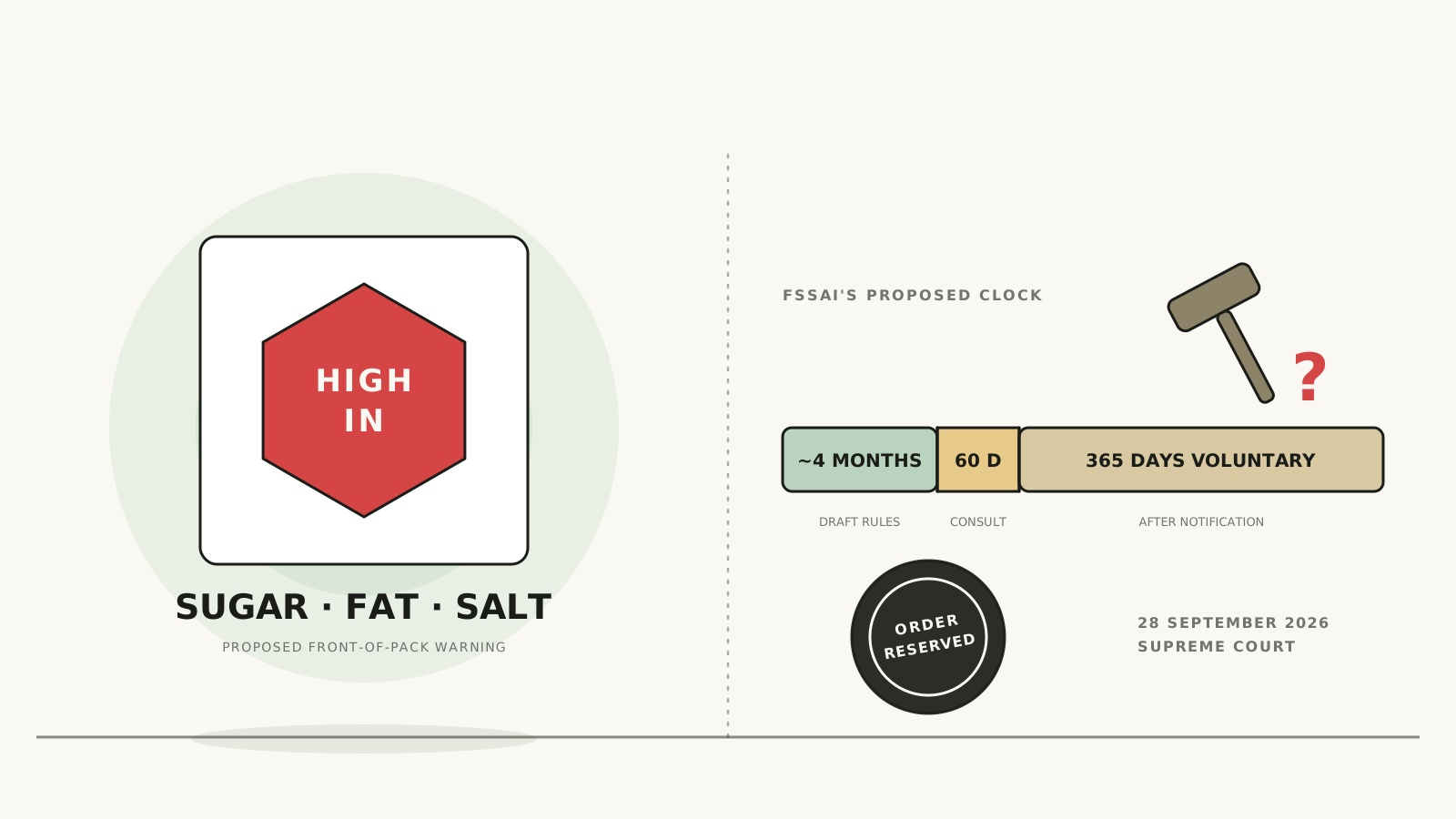
"Why voluntary compliance for a year? Why do you need so much time?" That was the question a Supreme Court bench reportedly put to FSSAI while hearing the front-of-pack warning label case. The court then reserved its order, and told the regulator that whatever it directs will be binding.
For anyone who sells packaged food in India, this is the moment the label on the front of your pack stops being a design choice. The court hasn't ruled yet. But the proposed timeline, the red hexagon design and the nutrient thresholds are now on record, and the bench has signalled it may set its own schedule.
Here's what was said, what FSSAI has proposed, and what brands should be doing before the judgment arrives.
Where the case stands
The matter is a public interest petition filed in 2024 by 3S and Our Health Society, a Kerala-based charitable organisation. It asks for mandatory front-of-pack labelling across states and Union Territories. The bench is Justice J B Pardiwala and Justice K Vinod Chandran.
On 28 September 2026, according to Business Standard, The Tribune and The Logical Indian, the bench reserved its order after hearing FSSAI's proposed roadmap. An earlier hearing on 11 September, reported by India Legal, covered how products should be classified and whether warnings should apply when only one nutrient is high.
The court has also pointed out that FSSAI began work on this in 2022, with the Indian Nutrition Rating star system, and has asked what happened in the four years since. According to reports, Justice Pardiwala told FSSAI, "Whatever order we now pass will be binding on you," and the bench added, "Do not disappoint us." Parties were reportedly asked to file final written submissions within three days.
What FSSAI has proposed
FSSAI told the court it wants a single-phase rollout. The reported design is a red hexagonal warning on a white square background, shown on packs that cross set thresholds for added sugar, saturated fat and salt. A separate warning would apply to products containing non-caloric sweeteners. The thresholds are said to be based on the Dietary Guidelines for Indians 2024 from ICMR-National Institute of Nutrition.
The timeline is the sticking point. As reported by The Tribune, FSSAI asked for:
- about four months to finalise the draft regulations,
- 60 days of stakeholder consultation, domestic and through the WTO,
- then 365 days of voluntary implementation after notification.
If those periods run back to back, that's roughly eighteen months before anything becomes mandatory, and the bench did not seem persuaded. It asked why compliance should be voluntary for a year and indicated it would decide a suitable timeline rather than accept the regulator's schedule.
Some design questions remain open. The court had earlier asked about warning size and design, how nutrient thresholds are fixed, what happens to existing stock, how sweetened beverages are treated, and whether assessment should be per 100 grams, per serving or both. At the 11 September hearing, FSSAI reportedly indicated it was willing to require a warning when even a single nutrient of concern is high, instead of waiting for two or more.
The arguments to watch
Two debates could change what ends up on your pack.
The first is "added" versus "total." FSSAI's proposal reportedly works from added sugar and added fat. The petitioners argued that warnings should address total sugar and fat content, not only added amounts. If the court agrees with the petitioners, products whose sugar comes from fruit, milk or other ingredients could fall under a warning they weren't planning for.
The second is classification. At the earlier hearing, the bench reportedly questioned why ultra-processed foods should get the same treatment as other packaged products. Senior Advocate Devadatt Kamat reportedly used Kurkure and salted cashews as examples of products that shouldn't automatically be treated alike just because both are packaged. Reports didn't make clear exactly whose argument that was, so treat the attribution with care. What matters is that the court is asking whether one threshold table fits every category, and the answer will decide how many of your SKUs carry a red label.
What This Means for Your Business
- Audit every SKU now. Run each product against the proposed added sugar, saturated fat and salt thresholds, using the Dietary Guidelines for Indians 2024 as the working reference.
- Check total and added. Model your numbers both ways, because the court may not stop at added sugar and fat.
- Flag sweetener products separately. Any product with non-caloric sweeteners may need its own warning, so list them early.
- Plan packaging lead times. Redesign, artwork approval and print runs take months, so ask your packaging vendors how fast they can turn a hexagon.
- Decide on stock. The court has asked about existing stock, so work out how much unlabelled inventory you'd hold on any given cut-off date.
Why act now
Don't count on 365 days. The bench has openly questioned that figure and said its order will bind FSSAI. A court-set deadline could be shorter, and it could arrive with little warning. Parties were reportedly told to file written submissions within days, so the judgment may not be far behind.
There's also a commercial angle. Brands that reformulate early or at least know which of their products would carry a red warning can make choices on their own terms: reformulate, resize, relabel or accept the label. Brands that wait will make the same choices under pressure, with printers booked and retailers asking questions.
The policy has been on the table since 2022. The only new fact is that a court now seems ready to set the clock.
How FoodOS360 Can Help
Working out which products cross which threshold is a data problem before it's a design problem. FoodOS360 lets compliance teams hold nutrient values, ingredient data and label claims for each SKU in one place, so you can test them against proposed thresholds as they change. It also tracks FSSAI drafts, circulars and court developments, so when the judgment is published you can see quickly which of your products it affects. It supports your team's decisions. It doesn't make them for you.
Conclusion
The Supreme Court hasn't decided yet, but the direction is clear enough to plan around: a red warning label, thresholds tied to Indian dietary guidance, and a timeline the court may shorten. Start your SKU audit now.
This article is meant for general information and isn't legal advice. Talk to a qualified food law professional before making labelling or formulation decisions based on this evolving case.